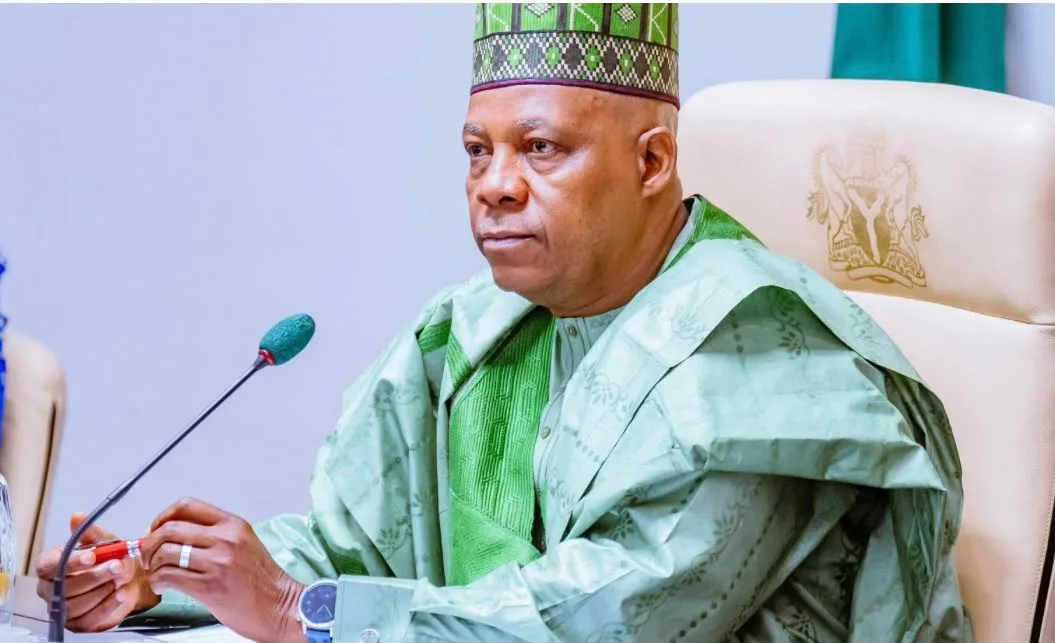
Vice President Kashim Shettima has challenged state governments to take advantage of the Electricity Act 2023 by establishing their own electricity regulatory agencies and developing independent solutions to persistent power supply problems.
Shettima said states must move beyond depending on the Federal Government and take practical steps to improve electricity generation, distribution and regulation within their jurisdictions.
He made the call on Wednesday at the National Stakeholders Workshop on the Electricity Act 2023, held at the State House Banquet Hall, Presidential Villa, Abuja.
The Vice President was represented by the Deputy Chief of Staff to the President, Senator Ibrahim Hassan Hadejia.
According to Shettima, the Electricity Act provides states with an opportunity to develop electricity markets suited to their economic needs and available natural resources, subject to applicable constitutional and statutory provisions.
He argued that decentralising the electricity sector would allow states to attract investments and develop energy solutions tailored to their local circumstances.
“State governors can fix electricity without the Federal Government. The size, diversity and endowments of this nation demand this decentralisation,” he said.
Shettima stressed that reliable electricity was essential to Nigeria’s industrial development, adding that businesses, households and public institutions require stable power to operate efficiently.
He urged state governors to translate the opportunities provided by the law into concrete investments and policies that would expand electricity access.
Highlighting the energy potential of different parts of the country, the Vice President pointed to solar power opportunities in Sokoto, Borno and Katsina states.
He also identified gas resources in Delta, Rivers and Bayelsa states, alongside hydropower opportunities in Niger and Kebbi states, as resources that could support state-led electricity development.
According to him, harnessing these resources could strengthen agriculture, manufacturing, healthcare and education while creating opportunities for economic growth.
The Vice President further emphasised that improving electricity supply required cooperation among the federal, state and local governments, alongside innovation and accountability in managing electricity markets.
He warned that the Electricity Act would have limited impact if states failed to establish the regulatory institutions needed to implement its provisions.
Shettima therefore urged states that had yet to establish their electricity regulatory agencies to do so without delay.
His remarks place renewed emphasis on the responsibility of state governments to turn the expanded powers under the Electricity Act 2023 into practical improvements in electricity access, investment and service delivery.
However, the effectiveness of the decentralised framework will depend on how quickly states establish functional regulatory institutions and attract the investment needed to develop their electricity markets.